AI Term of the Moment
Nervana
Definition: neural network
A major AI architecture employed for many pattern recognition applications. Hypothesized in the 1940s, there have been various elementary neural networks starting in the 1950s.
Layers and Nodes
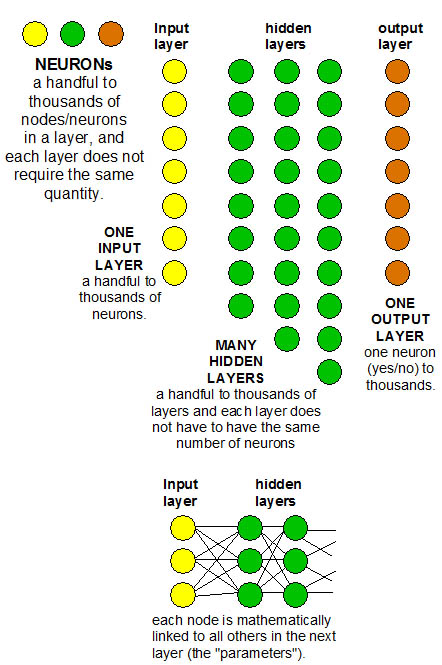
A neural network is a "math machine" that learns from examples. It comprises multiple layers of computational units called "nodes" or "neurons" that are mathematically connected to each other (see diagrams below). There is an input layer, an output layer and a handful to thousands of "hidden" layers in between.
Servers and GPUs
Datacenters can have a few servers or thousands. The more servers, the larger the neural network and the more comprehensive the training. For smaller AI applications, a single desktop machine can contain a neural network; for example, see DGX Spark.
A Single Node/Neuron
Tracing a Neuron
The neural network is a pattern detection system. The text in sentences (word, part of a word, etc.) is turned into a token that is converted into a one-dimensinal array called a "vector" or "embedding." Each layer transforms the embeddings mathematically by looking at the tokens in the sentence and making the embeddings more meaningful. The last layer predicts the next token.
The World's Information = One Giant Matrix
Essentially, AI companies have taken all the information ever published online and turned it into the world's largest mathematical matrix. See AI secret sauce and copyright infringement.
A Tiny Network
A Larger Network
There Are Many Network Designs
The following diagrams from the Asimov Institute in the Netherlands reveal the variety of neural network architectures. Note that whereas only a few layers are shown in each example, there can be hundreds or even thousands of layers depending on the network type.
The CNN: Easier to Understand
Convolutional neural networks (CNNs) are used to recognize images, text and handwriting, and their operation is easier to understand than chatbot models that appear to know everything. For details, see convolutional neural network.


Neural Network Architectures
Layers and Nodes
A neural network is a "math machine" that learns from examples. It comprises multiple layers of computational units called "nodes" or "neurons" that are mathematically connected to each other (see diagrams below). There is an input layer, an output layer and a handful to thousands of "hidden" layers in between.
Servers and GPUs
Datacenters can have a few servers or thousands. The more servers, the larger the neural network and the more comprehensive the training. For smaller AI applications, a single desktop machine can contain a neural network; for example, see DGX Spark.
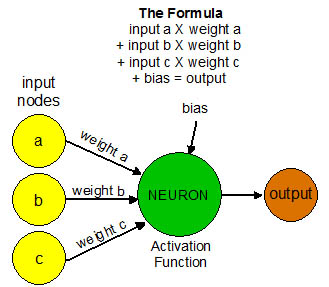
Nothing remotely like traditional "if-then-else" business logic, a neuron is a computational unit. Each layer contains a number of nodes/neurons and their mathematical values are computed with all the neurons in the next layer. The activation function determines the value that leaves the node and gets passed on. The weights and bias adjustment are modified in the training passes. See AI weights and biases.
Tracing a Neuron
The neural network is a pattern detection system. The text in sentences (word, part of a word, etc.) is turned into a token that is converted into a one-dimensinal array called a "vector" or "embedding." Each layer transforms the embeddings mathematically by looking at the tokens in the sentence and making the embeddings more meaningful. The last layer predicts the next token.
The World's Information = One Giant Matrix
Essentially, AI companies have taken all the information ever published online and turned it into the world's largest mathematical matrix. See AI secret sauce and copyright infringement.
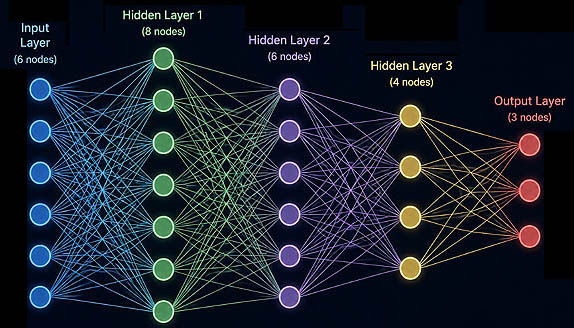
This neural network has only 17 neurons/nodes in three hidden layers and might be used for limited pattern recognition in a small sensor. (Image generated by ChatGPT.)
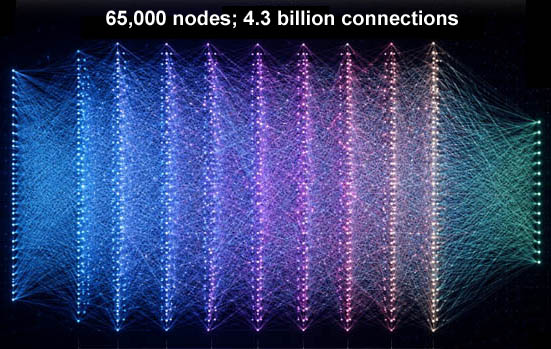
This neural network has 8,192 neurons/nodes in eight hidden layers for a total of 65 thousand nodes and 4.3 billion connections. Now imagine a neural network with 500 billion nodes and you can begin to visualize the complexity of large AI models. (Image generated by ChatGPT.)
There Are Many Network Designs
The following diagrams from the Asimov Institute in the Netherlands reveal the variety of neural network architectures. Note that whereas only a few layers are shown in each example, there can be hundreds or even thousands of layers depending on the network type.
The CNN: Easier to Understand
Convolutional neural networks (CNNs) are used to recognize images, text and handwriting, and their operation is easier to understand than chatbot models that appear to know everything. For details, see convolutional neural network.
AI networks are one of the most researched areas of computing in the 21st century. These examples reveal the many designs. (Images courtesy of Fjodor van Veen and Stefan Leijnen (2019). The Neural Network Zoo.)