AI Term of the Moment
Google AI Overview
Redirected from: artificial intelligence
Definition: AI
(1) For an index and springboard to more than 500 AI terms in this encyclopedia, see AI glossary.
(2) For Adobe's graphics application, see Adobe Illustrator.
(3) For Apple's AI, see Apple Intelligence.
(4) (Artificial Intelligence) Devices and applications that exhibit human intelligence and behavior. AI includes robots, self-driving cars, medical diagnosis, software programming and the generation of original text, images, poetry, videos, art and music from a description that can be simple or elaborate.
The Entire Field or One Application
AI may refer to the entire field of artificial intelligence or to a specific application of AI such as a chatbot like ChatGPT and Gemini. The term AI all by itself often implies an AI application; for example, "there's an AI to handle this." See AI agent and AI use cases.
Past and Present Buzzword
Although AI is the hottest topic on the planet today, it was first defined in the 1940s by English scientist, Alan Turing, who said, "a machine has artificial intelligence when there is no discernible difference between the conversation generated by the machine and that of an intelligent person" (see Turing test).
Will AI Eliminate Jobs?
Increasingly, people are concerned that AI will eliminate too many jobs. This is not unfounded because job loss is predicted by many experts, although others in the field say this is overhyped. Nevertheless, Elon Musk claims AI will cause substantial disruption by eliminating regular desk and white-collar jobs. Stay tuned! See AI anxiety.
A Twist in Terminology
In the tech world "intelligence" means processing capability. Therefore, your microwave oven is intelligent, but an AI that writes a poem based on your description is "artificially" intelligent. See intelligence, AI in a nutshell and AI glossary.

Blame It on the Gamers!
Where Are We Headed?

Want Details?
(2) For Adobe's graphics application, see Adobe Illustrator.
(3) For Apple's AI, see Apple Intelligence.
(4) (Artificial Intelligence) Devices and applications that exhibit human intelligence and behavior. AI includes robots, self-driving cars, medical diagnosis, software programming and the generation of original text, images, poetry, videos, art and music from a description that can be simple or elaborate.
The Entire Field or One Application
AI may refer to the entire field of artificial intelligence or to a specific application of AI such as a chatbot like ChatGPT and Gemini. The term AI all by itself often implies an AI application; for example, "there's an AI to handle this." See AI agent and AI use cases.
Past and Present Buzzword
Although AI is the hottest topic on the planet today, it was first defined in the 1940s by English scientist, Alan Turing, who said, "a machine has artificial intelligence when there is no discernible difference between the conversation generated by the machine and that of an intelligent person" (see Turing test).
Will AI Eliminate Jobs?
Increasingly, people are concerned that AI will eliminate too many jobs. This is not unfounded because job loss is predicted by many experts, although others in the field say this is overhyped. Nevertheless, Elon Musk claims AI will cause substantial disruption by eliminating regular desk and white-collar jobs. Stay tuned! See AI anxiety.
A Twist in Terminology
In the tech world "intelligence" means processing capability. Therefore, your microwave oven is intelligent, but an AI that writes a poem based on your description is "artificially" intelligent. See intelligence, AI in a nutshell and AI glossary.
Video game enthusiasm in the 1990s caused AI to flourish in the 2020s. Because gamers constantly demanded more speed to make their 3D games more realistic, NVIDIA kept making faster graphics processing units (GPUs) that later became the primary hardware for AI processing. See GPU.
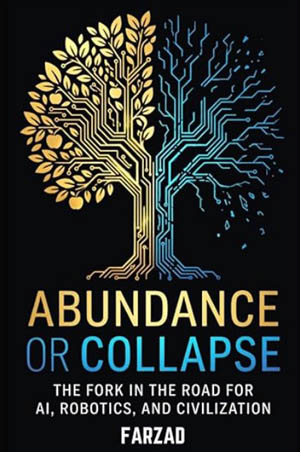
Along with half the world, that's the question Farzad Mesbahi asks in his provocative 2026 book, which is "must read" for everyone interested in AI. There is reason to believe AI can lead to a utopian society or bring about total collapse. Stay tuned! See AI utopia and AI anxiety.
The world's understanding of AI is in Stanford University's AI Index. The Artificial Intelligence Index Report covers the subject in exhaustive detail. For example, the 2026 index has 425 pages. See Stanford HAI.