AI Term of the Moment
neurosymbolic AI
Definition: AI chip
(1) For Google's AI chips, see Tensor Processing Unit and Tensor chip.
(2) For AMD's AI chips, see AMD Instinct.
(3) For Amazon's AI chips, see Amazon AI chips.
(5) For Microsoft's AI chip, see topological quantum chip.
(6) For NVIDIA's first AI chips, see GPU and CUDA.
(7) For Groq's AI language processing unit (LPU), see Groq.
(8) For a chip dedicated to AI image generation, see Normal Computing.
(9) For the photonic AI chip, see Native Processing Unit.
(10) For wafer-scale AI chips, see Cerebras AI computer.
(11) For low-power AI chips, see Normal Computing and Native Processing Unit.
(12) For the microcontroller that uses an AI convolutional neural network (CNN), see Pulsar.
(13) For companies that make AI chips, see semiconductor companies.
(14) The primary AI chip is the graphics processing unit (GPU). As desktop computers became more powerful in the late 1990s, the GPU debuted to render 3D graphics on screen for gamers. Because the GPU performs parallel operations, it became the logical processor for AI training and execution (inference), both of which require massive amounts of mathematical calculations in parallel. See AI training vs. inference and GPU.
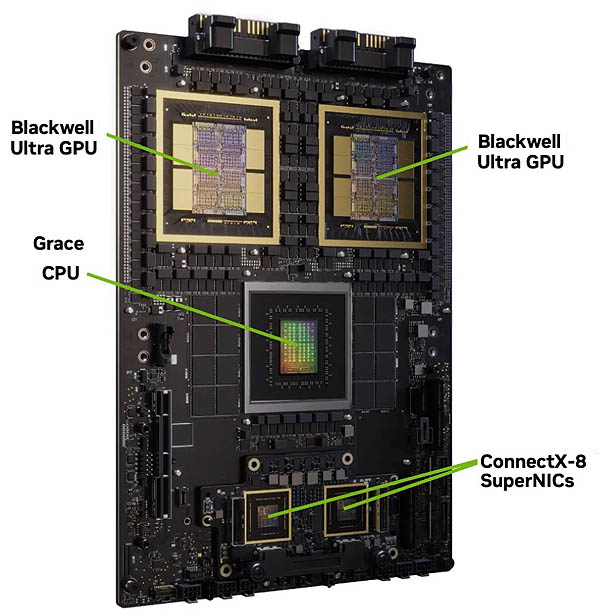
NVIDIA Grace Blackwell Superchip

The Versal System-on-Chip
What a Difference a Decade Makes
The ARM-based chips Apple designs and uses in its iPhones and iPads have evolved significantly over the years. There was no AI-based neural processing unit in 2015, but there was in 2025. See neural processing unit.
(2) For AMD's AI chips, see AMD Instinct.
(3) For Amazon's AI chips, see Amazon AI chips.
(5) For Microsoft's AI chip, see topological quantum chip.
(6) For NVIDIA's first AI chips, see GPU and CUDA.
(7) For Groq's AI language processing unit (LPU), see Groq.
(8) For a chip dedicated to AI image generation, see Normal Computing.
(9) For the photonic AI chip, see Native Processing Unit.
(10) For wafer-scale AI chips, see Cerebras AI computer.
(11) For low-power AI chips, see Normal Computing and Native Processing Unit.
(12) For the microcontroller that uses an AI convolutional neural network (CNN), see Pulsar.
(13) For companies that make AI chips, see semiconductor companies.
(14) The primary AI chip is the graphics processing unit (GPU). As desktop computers became more powerful in the late 1990s, the GPU debuted to render 3D graphics on screen for gamers. Because the GPU performs parallel operations, it became the logical processor for AI training and execution (inference), both of which require massive amounts of mathematical calculations in parallel. See AI training vs. inference and GPU.
AI "factories" may have hundreds of liquid-cooled server racks, each holding 36 of these Superchips that cost tens of thousands of dollars. Everything is connected via NVIDIA's NVLink. (Image courtesy of NVIDIA Corporation.)
Today's chips often include AI processing. This Versal system-on-chip (SoC) contains more than 30 billion transistors and provides circuits for AI processing (green area). It also contains programmable hardware, which means the actual circuits are programmed at startup, a rarity on any SoC (red area). See SoC, FPGA and Versal. (Image courtesy of AMD.)
What a Difference a Decade Makes
The ARM-based chips Apple designs and uses in its iPhones and iPads have evolved significantly over the years. There was no AI-based neural processing unit in 2015, but there was in 2025. See neural processing unit.
       Apple A9      Apple A19 Pro
        (2015)           (2025)

      2-core CPU       6-core CPU

      6-core GPU       6-core GPU
      6x 0.65GHz       6x 1.62GHz

         ---       16-core neural engine

      14 nm chip       2 nm chip